



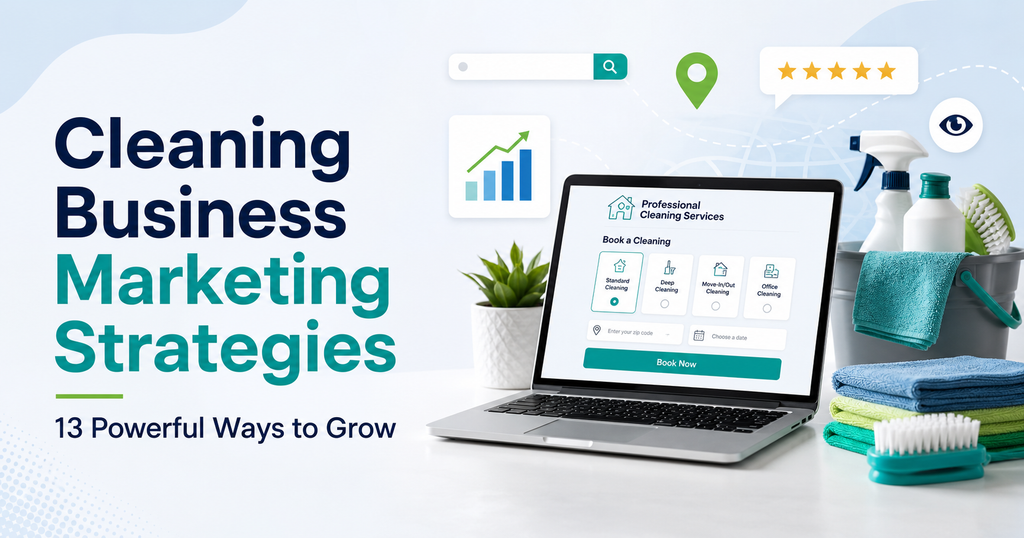
Cleaning business marketing strategies help local cleaning companies become visible, attract suitable customers, and generate more bookings. Providing an excellent cleaning service is important, but customers must first discover your business and feel confident enough to hire you.
People searching for cleaners often compare several companies. They inspect service details, read reviews, look at photographs, compare prices, and check whether online booking is available. If your company is difficult to find or contact, they may choose a competitor that makes the decision easier.
A practical marketing plan connects each stage of this journey. It introduces your company, establishes trust, and gives prospective clients a clear next step.
This guide presents 13 practical cleaning business marketing strategies you can use to strengthen your local presence and create sustainable growth.
What Are Cleaning Business Marketing Strategies?
Cleaning business marketing strategies are planned activities that promote your services to potential customers and encourage previous customers to return.
Marketing includes more than paid advertising. Your website, business name, Google Business Profile, customer reviews, booking form, referral program, social media content, and customer communication all contribute to how people view your company.
An effective strategy should help you:
- Reach customers within your service area
- Explain your services clearly
- Demonstrate the quality of your work
- Establish trust before the first appointment
- Convert interested visitors into bookings
- Encourage recurring cleaning appointments
- Generate recommendations from satisfied clients
The purpose is not to appear on every marketing channel. It is to meet suitable customers where they search, answer their questions, and make hiring your company convenient.
Why Cleaning Business Marketing Strategies Matter
Cleaning business marketing strategies give your promotional activities a clear direction.
Without a plan, you may spend money on advertisements without knowing whether they generate clients. You might post regularly on social media while ignoring local search results, where customers are actively looking for cleaners.
A structured approach helps you choose appropriate channels and measure real business outcomes. It can also prevent you from relying completely on discounts or word-of-mouth recommendations.
Effective cleaning business marketing strategies can help you:
- Improve local search visibility
- Generate qualified inquiries
- Build a recognizable brand
- Earn customer confidence
- Increase bookings
- Attract recurring clients
- Develop referral relationships
- Measure marketing performance
Each strategy should support a specific goal. A new company might focus on earning its first reviews, while an established business may want more commercial contracts or recurring residential appointments.
1. Define Your Ideal Customer
Successful cleaning business marketing strategies begin with a defined target customer.
A homeowner seeking weekly cleaning has different expectations from an office manager comparing commercial contractors. Marketing both services with one general message can make your business feel unsuitable for either customer.
Your ideal audience may include:
- Busy families
- Working professionals
- Apartment residents
- Landlords
- Property managers
- Vacation-rental hosts
- Real estate agents
- Offices
- Retail stores
- Construction companies
Identify the problems each group needs to solve. Families may value dependable scheduling and safe cleaning products. Property managers may prioritize fast turnaround between tenants. Commercial clients may require cleaning outside regular working hours.
When you understand these needs, you can create more relevant website pages, advertisements, service packages, and offers.
2. Research Your Local Market
Local research helps you find opportunities competitors have overlooked.
Search Google for cleaning companies in your city. Review their services, pricing, ratings, websites, and promotional messages. Notice which businesses appear prominently in local results and what they do well.
Next, look for weaknesses. Competitors may have unclear prices, outdated websites, slow response times, limited booking options, or poor customer reviews.
Read both positive and negative feedback. Positive reviews reveal what customers value. Complaints highlight frustrations you can avoid, such as late arrivals, inconsistent results, unexpected charges, or weak communication.
Use this information to define your advantage. You might focus on transparent pricing, simple online booking, flexible schedules, eco-friendly products, or specialized move-out cleaning.
3. Develop a Professional Brand
Branding is one of the most visible cleaning business marketing strategies.
Your brand includes your business name, logo, colors, uniforms, vehicle design, website, printed materials, and communication style. These elements should feel consistent wherever customers encounter your company.
Choose a name that is easy to remember and spell. Use a simple logo that remains clear on mobile screens, business cards, invoices, and uniforms.
Create a short positioning statement that explains whom you serve and what you provide. For example:
“Flexible residential cleaning for busy families in Austin.”
This message is more meaningful than a general claim that your company offers the best service.
Consistent branding creates familiarity. That familiarity can make customers feel safer when choosing a company to enter their property.
4. Build a Search-Friendly Website
A professional website is the foundation of most digital cleaning business marketing strategies.
Your website should answer the questions customers ask before booking. It should explain your services, locations, process, prices, and reasons to trust your team.
Include these essential elements:
- Individual service pages
- Service-area information
- Pricing or quote details
- Authentic testimonials
- Photographs of your work
- Frequently asked questions
- Contact information
- Visible booking buttons
Create separate pages for important services such as house cleaning, deep cleaning, office cleaning, carpet cleaning, and move-out cleaning. Each page should explain who the service is for and what it includes.
The site must also work well on mobile devices. Keep the text readable, pages fast, and navigation simple.
For more guidance, read this local SEO checklist for cleaning businesses.
5. Make Online Booking Convenient
Marketing may bring customers to your website, but the booking process determines whether they complete the next step.
Many customers search for cleaning services outside normal business hours. If they can only contact you by phone, they may choose a company that accepts online bookings.
An online booking system can allow customers to select a service, provide property details, choose a suitable date, and submit their information.
Cleanly is a WordPress cleaning service booking plugin. It provides single-step and multi-step forms, booking calendars, staff management, branch management, payment options, and customer review features.
Keep the booking form focused. Only request information necessary to understand, price, or schedule the service. Test the complete process on a phone before sending advertising traffic to it.
Convenience is one of the most practical cleaning business marketing strategies because fewer barriers can mean fewer abandoned inquiries.
6. Optimize Your Google Business Profile
A complete Google Business Profile helps your company appear when nearby customers search for cleaning services.
Add your correct business name, phone number, website, working hours, services, and service areas. Select the most accurate primary business category and include relevant secondary categories where appropriate.
Upload original photographs of:
- Your cleaning team
- Equipment and supplies
- Branded vehicles
- Completed work
- Uniforms
- Your business location
Ask satisfied customers to leave reviews and respond professionally to each review. Publish occasional updates about seasonal services, available appointments, or relevant company news.
Google provides an official guide and tools for creating a Google Business Profile. This external link can remain DoFollow because it points to a relevant and authoritative resource.
7. Invest in Local Search Engine Optimization
Local SEO is one of the most valuable long-term cleaning business marketing strategies.
Optimize your important service pages around phrases potential clients use. Examples include:
- House cleaning services in [city]
- Local deep cleaning company
- Office cleaners near me
- Apartment cleaning services
- Move-out cleaning in [city]
- Commercial cleaning company
Use keywords naturally in the title, opening paragraph, headings, body, image alt text, and meta description. Avoid forcing the same phrase into every sentence.
Create location pages only for areas you genuinely serve. Each location page should contain useful, original information. Do not duplicate the same page and replace only the city name.
Publish helpful blog content around customer questions. Topics can include preparing for professional cleaners, comparing standard and deep cleaning, or creating a move-out checklist.
These articles can attract search traffic and direct readers toward your service and booking pages.
8. Collect and Display Customer Reviews
Customer reviews provide evidence that your company delivers what it promises.
Cleaning customers want to know whether your team arrives on time, communicates properly, respects private property, and produces consistent results. Genuine reviews help answer those concerns.
Send a short review request after completing a service. Include a direct link so the customer does not need to search for your profile.
Do not instruct customers to write specific comments. Natural reviews are more persuasive because they describe different parts of the experience.
Respond to positive and negative reviews. Thank satisfied customers. If someone reports a problem, remain calm and offer to discuss the matter privately.
With permission, display selected testimonials on your homepage, service pages, social media profiles, and booking page.
9. Share Authentic Social Media Content
Social media marketing helps potential customers see the people, work, and personality behind your company.
You do not need to use every social network. Select the platforms where your local customers are active and maintain a realistic publishing schedule.
Useful content includes:
- Before-and-after results
- Quick cleaning tips
- Team introductions
- Customer testimonials
- Equipment demonstrations
- Seasonal reminders
- Frequently asked questions
- Behind-the-scenes videos
- Available appointment updates
- Community activities
Original photographs generally build more trust than generic stock images. Always obtain permission before sharing a client’s property. Remove addresses, documents, family photographs, and other identifying details.
Read this complete guide to social media marketing for cleaning businesses for platform-specific content ideas.
10. Use Google Ads for High-Intent Searches
Google Ads can reach people who are already searching for a cleaning company.
Create focused campaigns for valuable services and locations. An advertisement targeting “move-out cleaning in Denver” should direct visitors to a page specifically about that service.
Avoid sending every visitor to the homepage. A focused landing page creates a closer connection between the customer’s search and your offer.
Google provides official information about campaign options through its Google Ads platform. Keep this external link DoFollow because it is an authoritative resource directly connected to the topic.
Track phone calls, form submissions, confirmed bookings, acquisition costs, and revenue. Clicks alone do not reveal whether a campaign is profitable.
11. Run Focused Social Advertising
Facebook and Instagram advertisements can introduce your company to local customers who are not actively searching yet.
These platforms work well for visually presenting:
- Before-and-after results
- Seasonal cleaning packages
- First-time customer offers
- Authentic testimonials
- Local service announcements
Limit targeting to the cities and neighborhoods you serve. Test one audience and offer at a time so you can understand what produces results.
Do not increase spending based only on impressions or engagement. Measure quote requests and completed bookings.
Paid campaigns work better when the website, reviews, and booking experience already inspire confidence.
12. Build Referral and Partnership Programs
Referral programs turn satisfied customers into promoters.
Offer a simple reward when an existing customer introduces someone who completes a booking. The reward could be a service credit, an upgrade, or a discount on a future appointment.
Keep the conditions easy to understand. Complicated programs usually receive less participation.
You can also build relationships with businesses that serve similar customers, including:
- Real estate agents
- Property managers
- Moving companies
- Contractors
- Interior designers
- Home organizers
- Vacation-rental managers
Explain how your cleaning services can help their customers. Protect the partner’s reputation through dependable communication and consistent service quality.
Referral relationships can become some of the most cost-effective cleaning business marketing strategies.
13. Use Email to Encourage Repeat Bookings
Email supports cleaning business marketing strategies by helping previous customers remember and rebook your services.
With proper customer consent, send relevant messages such as:
- Appointment confirmations
- Cleaning reminders
- Review requests
- Seasonal service offers
- Referral invitations
- Rebooking prompts
- Service updates
- Helpful cleaning advice
Segment your audience where possible. A commercial client should not receive the same campaign as a residential customer who booked a one-time cleaning.
Each email should have one clear purpose and an obvious next step. Avoid sending frequent promotions without providing useful information.
For additional ideas, see this guide to email marketing for cleaning businesses.
How to Budget for Cleaning Business Marketing Strategies
A marketing budget should support growth without affecting essential operating expenses.
List the expected costs of your website, booking software, advertising, printing, photography, and promotions. Choose a monthly amount your business can maintain.
Track the following performance indicators:
- Cost per lead
- Cost per customer
- Website conversion rate
- Quote-to-booking rate
- Average booking value
- Repeat booking rate
- Revenue by source
Ask every new client how they discovered your business. This simple question helps identify whether Google, social media, referrals, advertising, or partnerships generate customers.
Review your results monthly. Increase investment in profitable channels and improve or stop activities that consistently fail to produce bookings.
Common Marketing Mistakes to Avoid
Even strong cleaning business marketing strategies can fail when the supporting experience is weak.
Avoid these common mistakes:
- Targeting everyone with the same message
- Competing only through low prices
- Using inconsistent business information
- Ignoring customer reviews
- Sending visitors to an outdated website
- Making online booking difficult
- Running ads without conversion tracking
- Using only generic stock images
- Publishing copied or repetitive content
- Marketing inconsistently
- Measuring followers instead of revenue
Choose a manageable marketing schedule. Consistent progress is more valuable than an intense campaign that stops after a few weeks.
Frequently Asked Questions
What are the best cleaning business marketing strategies?
The best cleaning business marketing strategies include local SEO, Google Business Profile optimization, customer reviews, referral programs, helpful content, targeted advertising, and online booking. The ideal combination depends on your location, audience, services, and budget.
How can I market my cleaning business locally?
Create a complete Google Business Profile, optimize local service pages, collect reviews, join relevant directories, share original local content, and build partnerships with complementary businesses.
How do I get more cleaning clients?
Define your ideal customer and promote services that solve their specific problems. Improve your search visibility, display evidence of your work, respond quickly to inquiries, and offer a convenient booking experience.
Do I need a website for my cleaning company?
A professional website is strongly recommended. It gives customers a reliable place to review your services, locations, prices, testimonials, and booking options. It also supports SEO and advertising.
How much should a cleaning company spend on marketing?
There is no universal amount. Set a budget that protects essential expenses and supports your goals. Start carefully, track confirmed bookings and revenue, and increase spending only when a channel generates profitable customers.
Final Thoughts
Cleaning business marketing strategies work when they combine visibility, credibility, and convenience.
Start with a clearly defined customer and a professional website. Improve your Google Business Profile, build local SEO pages, collect genuine reviews, and make online booking easy.
Add social media, advertisements, referrals, partnerships, and email campaigns as your capacity grows. Track the source of every lead and invest more in methods that produce profitable customers.
The objective is not simply to attract more attention. Effective cleaning business marketing strategies should help suitable customers discover your company, trust your team, complete a booking, and return after a positive experience.









Comments
Congratulations, you have the opportunity to be the first commenter on this article.
Have a question or suggestion? Please leave a comment to start the discussion.